

Irish Dance Competitions: How to Prepare for Your First Feis

For many dancers, their first Irish dance competition is a big step. A little bit of nervous anticipation, a new environment, beautiful costumes, music, the buzz backstage… and most importantly, the excitement of experiencing the atmosphere of a real feis for the very first time.
If you are completely new to competitions, there is no need to worry. Every experienced dancer once stood at their very first feis, and most of them still remember that special mix of nerves and excitement.
This article will help you understand:
what a feis actually is,
when it makes sense to enter your first competition,
how to prepare,
what you should not forget to pack,
and what usually happens on competition day.

What is a feis?
“Feis” (pronounced fesh) is the Irish word used for an Irish dance competition.
Dancers compete in categories according to:
age,
competition level,
and either individually or as part of a team.
At competitions, dancers perform:
Soft shoe dances: reel, light jig, slip jig, single jig
Hard shoe dances: treble jig, hornpipe, traditional set dance, treble reel, modern set dance.
You may also see team dances such as:
2-hand and 3-hand dances,
céilí dances.
But competitions are not only about results. For many dancers, they are mainly:
motivation to keep improving,
a chance to gain experience,
an opportunity to meet the Irish dance community,
and simply a wonderful experience.
When is a dancer ready for their first competition?
This is a very common question from both parents and adult beginners.
The truth is, you do not have to be “perfect” for your first feis. Nobody expects a flawless performance.
Your first competition is mainly about:
experiencing the atmosphere,
learning how competitions work,
dealing with nerves,
and gaining your first experience on stage.
Your teacher will help you decide when the right time is to enter a competition.
A dancer should:
know their competition dance from memory,
understand the basic technique,
be able to dance confidently with music,
and most importantly — want to give it a try.
How to prepare before the competition
1. Do not focus only on the steps
A competition is not just about “remembering the choreography”.
It is important to:
dance in time with the music,
complete your movements,
stay calm,
and perform even under pressure.
Very often, a dancer learns more from their first competition than from several regular classes.
2. Practise your competition performance
It helps to:
dance in front of other people,
practise without stopping,
play the music loudly,
practise walking on and off stage.
For many beginners, the hardest part is not the dancing itself — it is learning how to handle the nerves.
3. Do not overload yourself right before the competition
The final days before a feis are not the best time for:
trying to fix everything at the last minute,
hours of intense training,
or repeating your choreography over and over again.
It is much more important to:
feel rested,
have energy,
and arrive at the competition with a positive mindset.
What to pack for your first feis
Your first competition can also be a little bit of a logistical challenge. Preparing everything in advance makes the day much easier.

Basic checklist
Dance essentials
dance shoes,
poodle socks or black 70 DEN tights (for dancers over 18 years old),
costume or competition outfit (always check with your teacher),
competitor number (usually received at the competition venue),
hair ties and hair clips,
hairspray,
safety pin (for attaching your competitor number).
Practical items
water,
light food and snacks,
comfortable clothes for waiting,
plasters,
towel,
deodorant,
phone charger.
Useful extras
hairbrush/comb,
small makeup kit (not used for children under 12),
headphones or a book for longer waiting times.
What happens on competition day?
1. After arrival
Once you arrive, you need to:
find the changing area,
collect your competitor number (usually from your teacher, school representative, or registration desk),
check the timetable.
At larger competitions, several stages may run at the same time, so everything can feel a little confusing at first. That is completely normal.
2. Warm-up
Before dancing, it is important to:
warm up your body,
do some light jumps,
stretch dynamically,
and most importantly — calm yourself down.
Beginners often underestimate their warm-up because they are nervous.
3. Waiting for your competition
Irish dance competitions do not always run exactly according to schedule.
Sometimes you wait longer than expected, and sometimes your competition starts surprisingly early.
It is always good to:
follow what is happening,
listen to announcements,
have your shoes and costume ready.
Remember: dancers should be dressed, warmed up, and ready to dance up to 30 minutes before their scheduled time. If the competition is running ahead of schedule, the organisers may start earlier.
4. Going on stage
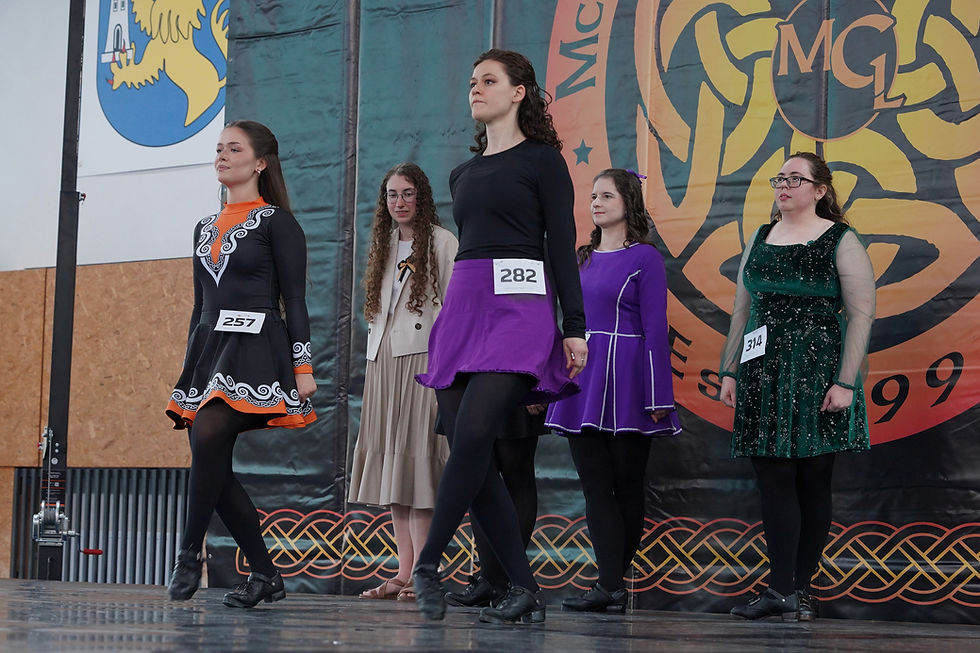
In continental Europe, competitions usually work in a way where dancers come on stage separately for each dance.
For example, when the Basic Reel competition is announced, all dancers competing in that dance gather beside the stage.
If there are multiple stages, dancers must make sure they are at the correct stage according to the timetable.
Stage assistants organise competitors according to their numbers. The whole group then walks onto the stage together.
The adjudicator writes down all competitor numbers and only then will the music start.
In beginner levels, stage assistants usually count the first 8 bars of music to help dancers start.
Dancers usually perform in groups of 2–3 at the same time.
After finishing their dance, competitors bow and return to their place in the line, making sure not to cross in front of dancers who are still performing.
They wait until everyone in their competition has finished. Then the whole line bows to the adjudicator, then to the musician (yes, Irish dance competitions always have live music), and only then leaves the stage.
The same process continues for the following dances.
At your first competition, the most important thing is not a perfect performance.
The most important things are:
finish your dance,
keep going even if you make a mistake,
and enjoy the experience.
Because almost everyone makes mistakes sometimes. The audience and adjudicators usually notice much more how a dancer continues rather than the mistake itself.

What is the hardest part for beginners?
Nerves
Completely normal.
It helps to:
focus on the music,
breathe,
avoid comparing yourself with others,
and remember why you dance.
Comparing yourself to others
At a feis you will see:
beautiful costumes,
experienced dancers,
big wigs and makeup.
But everyone started somewhere.
Your first competition is not about “being the best”.
It is about taking your first step into the competition world.
What if something goes wrong?
Maybe you:
forget part of your dance,
start on the wrong foot,
dance too fast or fall behind the music,
or simply get overwhelmed by nerves.
All of this can happen at your first competition.
A feis is not only about medals.
It is an experience that helps dancers grow:
technically,
mentally,
and in confidence.
Why are Irish dance competitions so addictive?
Because they combine:
dancing,
adrenaline,
community,
personal challenge,
and the joy of movement.
And that is exactly why dancers keep coming back.
Final thoughts
If you or your child are preparing for your first feis:
You do not have to be perfect.You do not have to know everything.And feeling nervous is completely normal.
The most important thing is taking that first step.
Because your first competition can be the moment when “I go to dance classes” turns into a lifelong love for Irish dance.
Would you like to explore the world of Irish dance competitions?
Competitions are just one of many paths you can take in Irish dance. For some dancers, they become a great source of motivation and a way to challenge themselves, while for others they are simply a chance to experience the unique atmosphere, meet other dancers, and become part of the wider Irish dance community.
If the competition world interests you but you are not sure where to begin, we are happy to help you find your way. Whether you are just starting your Irish dance journey or already have some dance experience, feel free to reach out with your questions or come and discover how we share our love for Irish dance at inSpiral.

Comments